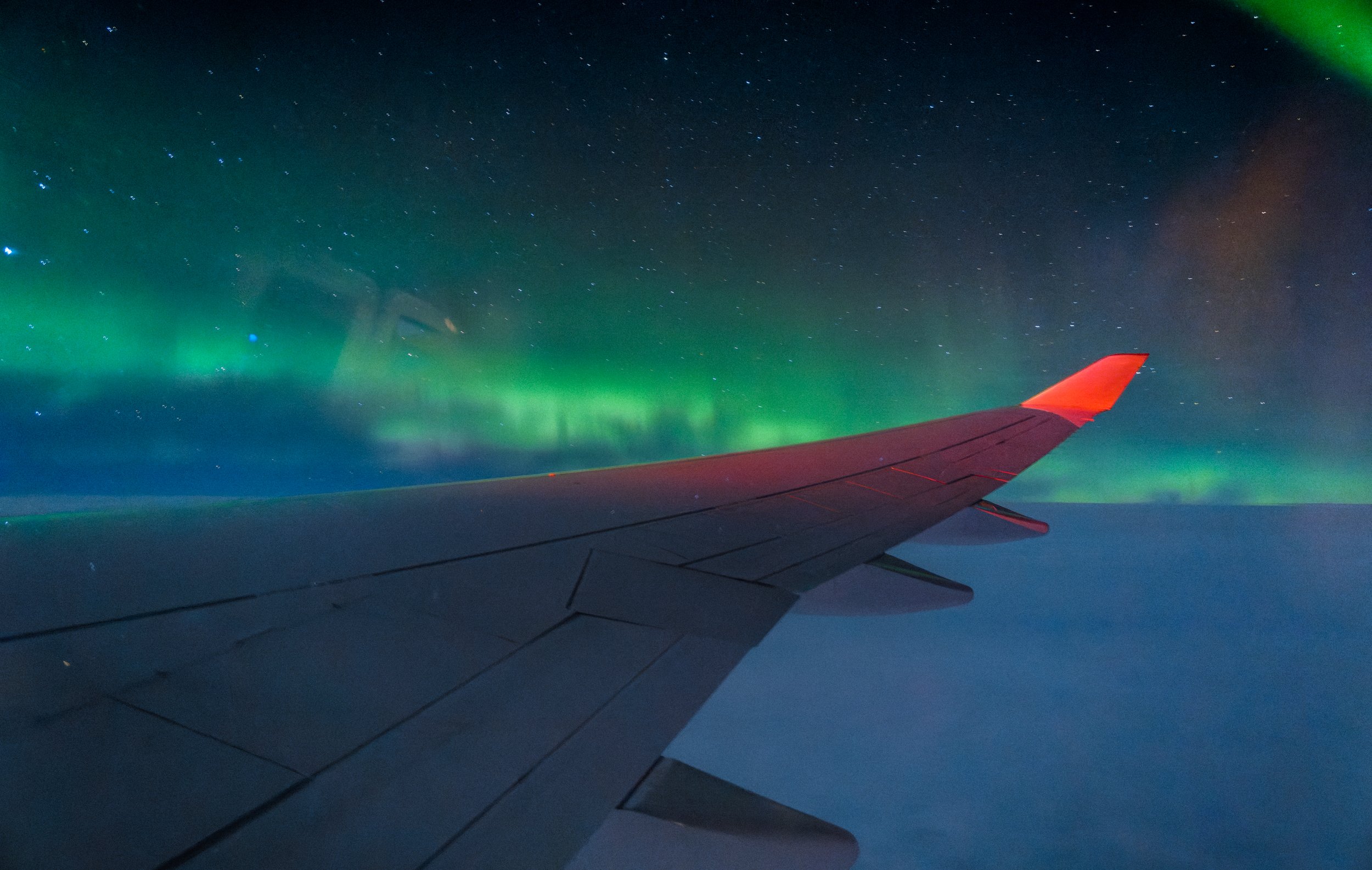
I used to think that seeing the aurora from a plane was extremely rare and difficult to capture. After several transatlantic flights between Canada and Europe, I’ve learned that with a bit of planning, it’s actually easier than you might expect.
While many of these tips apply to smartphones, this guide is written primarily for those using a DSLR, mirrorless, or advanced compact camera. I shoot most of my images on a Canon R5 and a Leica Q2 Reporter, but the same principles apply to any camera that allows manual control of exposure and focus.
1. Timing matters
To see the aurora, it needs to be dark outside. Night flights, especially red-eye routes between North America and Europe offer the best chances. Avoid summer months, when the sky can remain bright for much of the night. The darker the sky, the stronger the contrast and colour you’ll see from the window.
2. Check conditions before you fly
Before departure, check an aurora forecast app such as My Aurora Forecast. These apps show the KP index and the position of the auroral oval (sometimes called the aurora ring).
The KP index is a global scale that measures geomagnetic activity, ranging from 0 to 9. The higher the number, the stronger and more widespread the aurora is likely to be. A KP of 0–2 usually means limited activity, while anything above 4 suggests a strong chance of visible aurora. However, when flying far north you don’t need a high KP to see the lights. Even a KP of 1 can produce a good display from high latitudes.
3. Choose your seat carefully
A north-facing window seat is ideal but not essential. On most transatlantic flights between Canada and Europe, that means sitting on the left side of the aircraft when flying east and the right side when heading west.
At very high latitudes, such as over northern Greenland or northern Canada, you can often still photograph the aurora even from a south-facing seat.
Once on board, use the in-flight map to track your position and look for activity when you’re farthest north.
4. Spot the aurora with your eyes and camera
Aurora can appear faint to the naked eye, often as soft, greyish clouds rather than vivid ribbons of light. If you think you’re seeing something, take a quick test photo with your phone or camera. cameras can reveal colour and structure that are invisible to your eyes.
Camera setup and exposure basics
5. Shoot RAW for flexibility
Shooting in RAW gives you maximum control in post-production. It preserves highlight and shadow detail, allows for accurate white balance correction, and produces better results when applying denoising software.
6. Choose the right lens
A wider lens gives you more sky coverage and helps manage vibration from the aircraft. In most cases, a focal length between 24mm and 35mm works best. Go wide enough to capture the sky but not so wide that you include the edges of the window, which often look distorted or reflective.
7. Set aperture first
Use your lens’s widest aperture, ideally between f/1.4 and f/2.8. This does two things:
It allows more light to reach the sensor, helping you keep ISO and shutter speed manageable.
The shallow depth of field blurs the airplane window, softening scuffs, frost and other imperfections.
8. Dial in shutter speed
The aurora moves, and so does your plane. You’ll need to balance gathering enough light with keeping your image sharp. A shutter speed between one and four seconds is usually ideal. It’s long enough to capture colour and movement but short enough to minimize motion blur.
If your camera or lens includes image stabilization (IBIS or IS), turn it on. It can make the difference between a slightly soft frame and a sharp, usable image when shooting handheld.
9. Set ISO last and don’t fear the noise
Don’t hesitate to use high ISO settings. Modern cameras and software handle noise well. I often shoot between ISO 3200 and 12800, and sometimes higher. Prioritize proper exposure over grain. It’s better to have a bright, well-exposed photo than a dark one you can’t recover.
Noise can always be reduced later. Denoising tools in Lightroom or programs such as DxO PureRAW can clean up high-ISO images while preserving fine detail. Both of the sample images shown below were processed this way.
10. Focus manually
Autofocus often struggles in low light and through airplane glass. Switch to manual focus and either focus on the wing tip, which will be close to infinity on a wide lens, or set your lens to infinity and back it off slightly. This ensures the aurora and stars remain sharp.
11. Adjust white balance
A white balance near 4000 Kelvin generally produces natural tones, but treat this as a starting point. Aurora colour varies depending on altitude and intensity. I often fine-tune the white balance manually in Lightroom, especially to balance green and magenta tones.
12. Eliminate reflections
Cabin light is your biggest enemy. Turn off your seat’s entertainment screen, switch off reading lights, and wrap a jacket or sweater around your lens to block reflections. Pull the window shade down as much as possible while still letting your camera see out. The darker your cabin environment, the cleaner your shot will be.
13. Compose with intention
It’s easy to focus only on the aurora, but what makes this special is seeing it from an airplane. Let your photo tell that story. I often include the wing as a foreground element. It acts as a leading line toward the aurora and can also show where you’re flying, depending on the airline branding.
Be mindful of the plane’s navigation lights, which blink periodically on the wingtips. They can work for or against your composition depending on colour and timing.
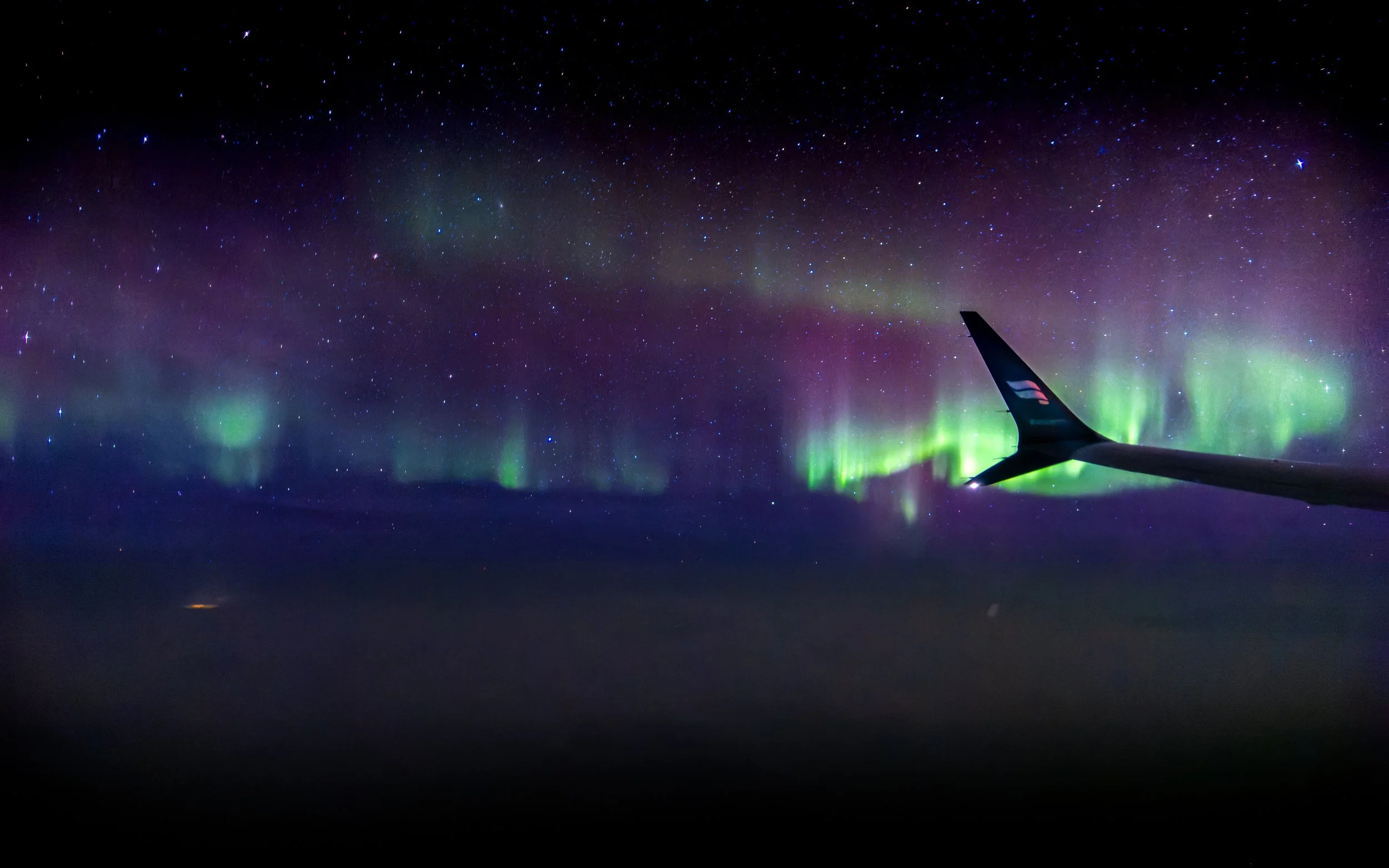
In my Icelandair photo, I was seated on the left side of the plane, where the wing-tip light glows red. I found that colour distracting, so I shortened my shutter speed to one second and timed my shots between flashes.
In another image, I was on the right side of the aircraft, where the light is green. Because of my angle, I avoided shooting directly into it but allowed some of the green glow to illuminate the wing. It acted like a subtle flash mounted outside the plane.
14. Work quickly
Aurora displays change fast, and the aircraft is always moving. Take a few test frames, fine-tune exposure and composition, and then shoot short bursts before the scene shifts.
Bonus tip for phone shooters
Modern smartphones can capture aurora surprisingly well in night mode. Hold your phone tightly against the window and pull the shade down over it as far as you can while still pressing the shutter button. This stabilizes the phone and blocks most cabin light. Keep the lens clean, stay steady and let the long exposure do the work.
Even if you don’t plan to stay awake for a red-eye flight, keep your camera close. The best aurora moments happen quietly, somewhere over the high arctic while everyone else is asleep.